Fetal Cardiology Diploma By ASFMS
*Level Up Your Fetal Cardiology Skills With Expert-Led Training*
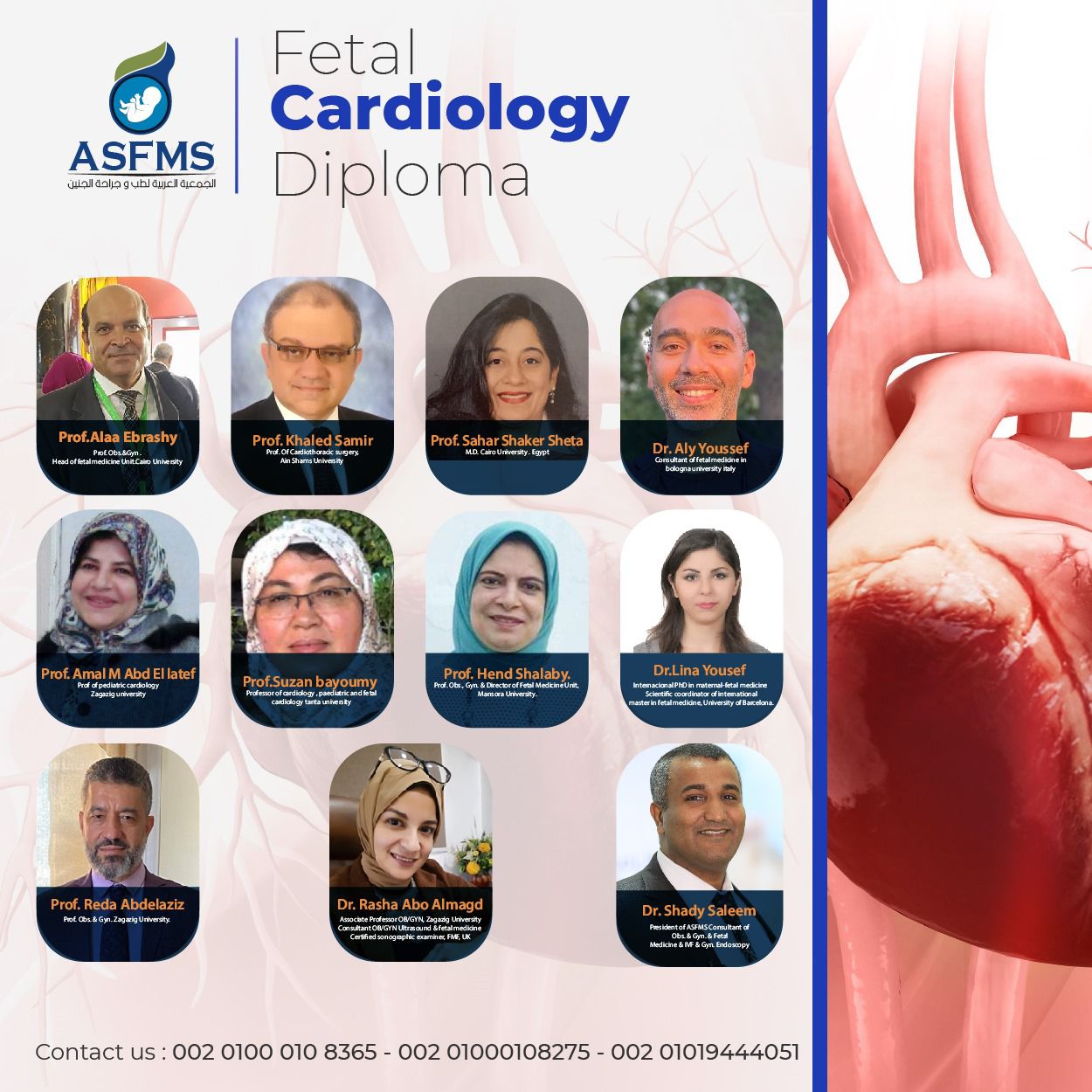
Elevate your fetal cardiology expertise with our in-depth diploma. Led by a distinguished faculty of fetal medicine doctors, pediatric cardiologists, and cardiothoracic surgeons with extensive clinical and teaching experience, you'll gain cutting-edge knowledge and practical skills in all aspects of fetal cardiology, aligned with the most recent guidelines.
Who Is This Diploma For?
Our advanced course is designed for qualified Obstetricians & Gynecologists, Fetal Medicine Specialists, Cardiologists, and Pediatric Cardiologists seeking to enhance their skills in fetal medicine.
Diploma Requirements
1) Students must be able to demonstrate competence in English.
2) The Graduation Certificate.
3) All Post-graduate Certificates.
4) The most recent C.V.
What You'll Learn
This intensive program explores all critical aspects of fetal cardiology. Led by a team of renowned subspecialists, including fetal medicine doctors, pediatric cardiologists, and cardiothoracic surgeons, you'll gain firsthand knowledge through their expertise.
Unveiling the Fetal Heart:
Explore the fascinating development and anatomy of the fetal heart.
Gain a deep understanding of the chambers and major vessels.
Mastering Advanced Techniques:
Master advanced techniques in fetal echocardiography, including the use of Doppler technology for detailed blood flow analysis and in-depth evaluation of congenital heart defects.
Gain expertise in identifying and understanding a range of heart malformations, including:
1) Aortic Stenosis & Hypoplastic Left Heart Syndrome
2) Septal Defects (Atrial, Ventricular, & Atrioventricular)
3) Ebstein Anomaly & Tricuspid Valve Issues
4) Tetralogy of Fallot & Other Complex Defects
5) Fetal Arrhythmias
Why Should You Enroll In This Diploma?
The main objective of our diploma is to enable participants to perform expert diagnosis and
counseling of prenatal heart anomalies by in-depth
knowledge of fetal cardiac physiology.
Our specific objectives:
• To achieve optimal prenatal acquisition of images
for evaluation of fetal cardiac physiology.
• To efficiently incorporate into fetal
echocardiographic evaluation all related techniques,
including 2D grayscale, M-mode, color and spectral
Doppler, 4D-STIC, tissue Doppler, strain, and magnetic
resonance imaging.
• To enable participants to perform expert diagnosis
and counseling of congenital prenatal heart anomalies.
• To enable participants to properly assess fetal
cardiac function in a clinical context.
• To enable participants to perform expert diagnosis,
treatment, and counseling of fetal arrhythmias.
• To recognize indications, limitations, and benefits of
in utero cardiac therapy, in a clinical context.
• To predict how the fetal heart adapts to an insult, and
consequently predict fetal cardiac remodeling, dysfunction,
and failure.
By mastering these in-demand competencies, you'll become a valuable asset in the field of fetal cardiology. You'll play a vital role in improving prenatal diagnosis, allowing for earlier intervention and better outcomes for pregnancies affected by congenital heart defects.
Topics And Modules Covered In The Diploma
1- Normal and abnormal development of fetal heart.
2- Indications of fetal echocardiography.
3- Fetal cardiac function and fetal circulation.
4- Techniques of fetal echocardiography (ISUOG
guideline 2023).
5- Abnormalities of four-chamber view and
abnormalities of great arteries.
6- Fetal cardiac morphometry.
7- Fetal cardiac rhythm.
8- Fetal systolic function.
9- Fetal diastolic function.
10- Atrioventricular septal defect (Complete or partial).
11- Ventricular septal defect (Perimembranous or
muscular).
12- Atrial septal defect.
13- Double inlet single ventricle.
14- Hypoplastic left heart (Mitral atresia or aortic
atresia).
15- Aortic stenosis.
16- Coarctation of the aorta.
17- Interrupted aortic arch.
18- Tricuspid atresia.
19- Ebstein anomaly and tricuspid dysplasia.
20- Pulmonary stenosis and atresia.
21- Fallot complex.
22- Truncus arteriosus.
24- Double outlet right ventricles.
24-Double outlet right ventricle.
25- Situs anomalies (Isomerism).
26- Fetal cardiac tumors.
27- Cardiomyopathies.
28- Other cardiac anomalies (Ductus arteriosus
restriction, pericardial effusion, ectopia cordis, and
echogenic foci).
29- Aortic arch anomalies.
30- Aystemic venous return anomalies.
31-Anomalous pulmonary venus return.
32-Fetal arrhythmia :classification,tachyarrhythmias
and bradycardia.
33- Fatal aortic vulvoplasty.
34- Fetal atrial septostomy.
35- Fetal pulmonary valvuplasty.
36-The growth restricted heart.
37-Fetal heart in assisted reproductive technologies.
38-Fetal heart infections.
39-Fetal heart in monochorionic twins.
40- Fetal heart in DM.
41- Fetal heart in diaphragmatic hernia.
42- Fetal congestive heart failure.
43-Genetics of congenital heart anomalies.
44-first trimester heart examination.
45-Obstetric management of the pregnancy.
complicated by fetal heart disease.
46- Three-dimensional echo reconstruction of the fetal.
heart (STIC).
47-Impact of fetal echocardiography on postnatal
outcome.
48- Fetal heart MRI.
49- Doppler in fetal heart(spectral color and tissue
Doppler.
49- Recent advances in fetal echocardiography.
50- Counseling following a prenatal diagnosis of
congenital heart disease.
The Arab Society Of Fetal Medicine And Surgery: Who Are We?
The Arab Society of Fetal Medicine & Surgery (ASFMS), founded in 2014, is a leading organization in Egypt, the Arab world, and Africa. Our main focus is on improving the skills of doctors in obstetrics and gynecology, particularly in fetal medicine and surgery. We offer training programs based on the latest advancements in the field and cater to the needs of doctors and trainees.
Our goal is to ensure the highest level of medical care for mothers and babies.
Watch Some Of Our Students' Testimonials
احجز مكالمتك دلوقتي
* التسجيل آمن و بنحترم خصوصيتك *